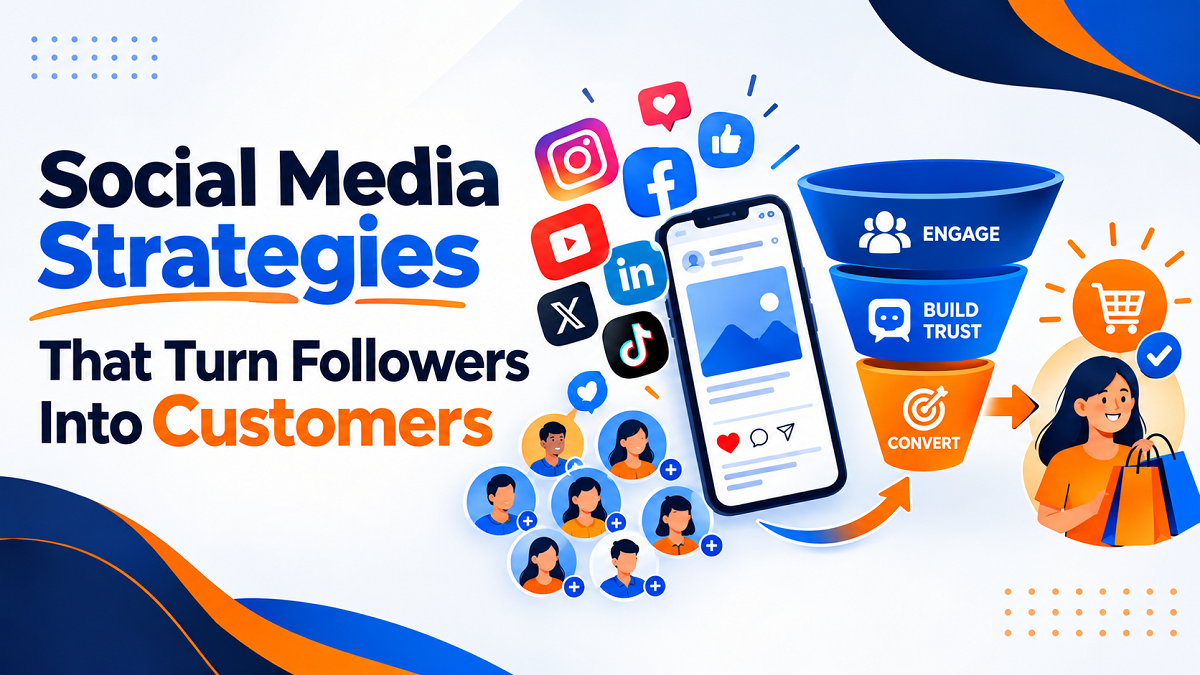
Having thousands of social media followers may look impressive, but followers alone do not automatically grow a business. The real value of social media comes when people who follow your brand start visiting your website, contacting your business, requesting information, and eventually becoming customers.
Many businesses spend time creating posts, reels, images, and promotional content but still struggle to generate meaningful results. The problem is often not the number of followers. It is the strategy behind those followers.
A successful social media strategy should do more than increase likes and reach. It should build trust, communicate value, create conversations, and make it easy for interested people to take the next step.
For small businesses and growing brands, social media can become an effective part of a wider digital marketing strategy when it is used with a clear purpose.
Why Followers Do Not Always Become Customers
A person may follow a business for many different reasons. They may like the content, want useful information, be interested in future offers, or simply want to keep up with the brand.
Following a page does not mean that the person is ready to buy.
This is why businesses should not measure social media success only through follower count. A smaller audience that trusts your brand can be more valuable than a large audience that never interacts with your business.
The goal should be to move people through a simple journey:
Discover → Follow → Trust → Engage → Visit → Enquire → Purchase
Your content and social media activities should support this journey.
1. Understand Your Target Audience
The first step is knowing who you want to reach.
Before creating content, identify the type of customer your business wants to attract. Consider their needs, problems, interests, location, buying habits, and the questions they commonly ask.
For example, a local digital marketing agency may target:
- Small business owners
- Local service providers
- Startups
- E-commerce businesses
- Professionals
- Companies looking for more online leads
Once you understand your audience, it becomes easier to create content that feels relevant.
Instead of posting random promotional messages, you can create content around real customer problems and provide useful solutions.
2. Create Content That Solves Problems
People rarely follow a business because they want to see advertisements every day.
They follow businesses that give them something useful.
Your social media content should answer questions, explain difficult topics, share practical tips, and help people make better decisions.
For a digital marketing business, useful content could include:
- SEO tips for small businesses
- Google Business Profile optimization tips
- Social media marketing ideas
- Website conversion tips
- Google Ads mistakes
- Content marketing strategies
- Local SEO recommendations
- Lead generation techniques
When your content consistently helps people, your business becomes more than another company appearing in their social media feed. It starts becoming a useful source of information.
3. Build Trust Before Asking for a Sale
One of the biggest mistakes businesses make on social media is trying to sell too quickly.
A new follower may not know your business, understand your service, or trust your claims. Asking them to buy immediately can create resistance.
Instead, use content to build trust.
You can demonstrate your knowledge through educational posts, practical examples, case studies, industry insights, customer experiences, and transparent explanations.
Trust develops when your audience repeatedly sees useful and honest information from your brand.
Read Also: 5 Digital Touchpoints Customers Check Before Calling a Local Business
Once people understand your expertise, they are more likely to consider your products or services when they have a relevant need.
4. Use Different Types of Content
Posting the same type of content repeatedly can make your social media presence predictable.
A better strategy is to use different content formats for different purposes.
Educational Content
Educational posts teach something useful. They can help establish expertise and attract people searching for solutions.
Problem-Solving Content
This type of content focuses directly on common customer problems and explains possible solutions.
Social Proof
Customer reviews, testimonials, project results, and case studies can help reduce uncertainty before a purchase.
Behind-the-Scenes Content
Showing the people and processes behind your business can make the brand feel more authentic and relatable.
Promotional Content
Promotional posts can introduce services, products, discounts, packages, or special offers.
The key is balance. Your audience should receive value instead of seeing constant sales messages.
5. Create Strong Calls to Action
Good content can attract attention, but the audience also needs to know what to do next.
A call to action, often called a CTA, gives people a clear next step.
Depending on your objective, a CTA could encourage users to:
- Visit your website
- Read a detailed guide
- Contact your business
- Request a quote
- Book a consultation
- Send a message
- Download a resource
- Explore a service
For example, instead of ending a post with a general statement, you can guide interested users toward a relevant service page or useful article.
The CTA should match the purpose of the content and should not feel misleading or overly aggressive.
6. Make Your Website Part of Your Social Media Strategy
Social media should not always be the final destination.
Your website can provide the detailed information that a social media post cannot.
For example, a short social media post about SEO may introduce a problem and provide one useful tip. The post can then direct interested users to a detailed SEO guide on your website.
This creates a natural connection:
Social Media → Website → Information → Trust → Enquiry
Make sure the landing page matches the message of your social media content. If someone clicks a post about a particular service and reaches an unrelated page, they may leave immediately.
A relevant, fast, easy-to-navigate website can make your social media traffic much more valuable.
7. Use Social Proof to Reduce Buying Hesitation
People often want reassurance before spending money.
Social proof can help them understand that other customers have trusted your business.
Depending on your business, useful forms of social proof can include:
- Genuine customer reviews
- Testimonials
- Case studies
- Portfolio examples
- Before-and-after results where appropriate
- Customer feedback
- Business achievements
Always use genuine information. Avoid creating fake reviews, fake testimonials, or exaggerated claims.
Authentic social proof can strengthen credibility without misleading potential customers.
8. Focus on Engagement, Not Just Reach
A post reaching 50,000 people may look successful, but reach alone does not tell you whether those people were interested in your business.
Pay attention to meaningful actions such as:
- Comments
- Saves
- Shares
- Website visits
- Messages
- Enquiries
- Sign-ups
- Leads
- Sales
These metrics can help you understand whether your content is attracting the right audience.
For example, a post with fewer views but several qualified enquiries may be more valuable to a business than a viral post that produces no customers.
9. Turn Comments and Messages Into Conversations
Social media is not only a publishing platform. It is also a communication channel.
When someone asks a question in a comment or sends a message, respond clearly and professionally.
A useful response can turn casual interest into a genuine business conversation.
Avoid sending the same promotional message to everyone. Understand what the person needs first, then provide relevant information.
Fast and helpful communication can also improve the overall customer experience.
10. Use Paid Advertising Strategically
Organic social media can help build an audience, but paid advertising can help businesses reach specific groups of people.
Social media advertising can be used for objectives such as:
- Brand awareness
- Website traffic
- Lead generation
- Product promotion
- Retargeting
- Event promotion
However, spending money on ads does not automatically produce good results.
Before launching a campaign, define the audience, objective, offer, landing page, budget, and measurement method.
A well-designed campaign should focus on the quality of the traffic and leads rather than simply generating impressions.
11. Retarget Interested Visitors
Not everyone will become a customer during their first interaction with your brand.
Someone may visit your website, view a service, read an article, or interact with your social media content and leave without taking action.
Retargeting can help businesses reconnect with eligible audiences through appropriate advertising campaigns.
This is particularly useful because the audience may already have some familiarity with your business.
However, retargeting should be implemented responsibly and in accordance with the relevant platform rules, privacy requirements, and applicable laws.
12. Track What Actually Generates Customers
A social media strategy should improve over time.
Review your performance regularly and identify which content produces meaningful business outcomes.
Useful metrics may include:
- Engagement rate
- Website clicks
- Landing page visits
- Leads
- Cost per lead
- Enquiries
- Conversion rate
- Sales generated
Do not change your entire strategy based on one post.
Look for patterns over time. If educational content consistently generates website visits while promotional posts generate very little engagement, that information can help you improve your content mix.
13. Be Consistent Without Becoming Repetitive
Consistency helps your audience remember your brand.
However, consistency does not mean publishing the same message every day.
Create a realistic content schedule that your business can maintain. It is better to publish useful content consistently than to post a large amount of low-value content for a short period and then disappear.
Your content should have a recognizable brand voice while still offering variety.
14. Make the Buying Journey Simple
Even if your social media strategy is excellent, customers can still drop off if the buying process is complicated.
Make it easy for interested users to understand:
- What you offer
- Who your service is for
- What problem you solve
- How they can contact you
- What happens after they contact you
- Where they can learn more
Remove unnecessary steps wherever possible.
A simple customer journey can help reduce confusion and improve the chance that an interested follower becomes a genuine lead.
A Simple Social Media Conversion Framework
Businesses can use this simple framework to build a more effective strategy:
Attract: Publish useful content that reaches the right audience.
Educate: Explain problems, solutions, and industry topics clearly.
Engage: Respond to comments, questions, and messages.
Build Trust: Use expertise, genuine customer experiences, and helpful information.
Convert: Give interested users a clear next step.
Measure: Track leads, enquiries, website actions, and sales.
Improve: Use the data to refine your strategy.
This approach keeps social media focused on business outcomes instead of vanity metrics alone.
Final Thoughts
Turning social media followers into customers does not happen simply by increasing your follower count. It requires a strategy that connects useful content, trust, engagement, website experience, and clear conversion opportunities.
The strongest social media presence is not necessarily the one with the largest audience. It is the one that attracts the right people and gives them a reason to trust the business.
For businesses looking to grow online, social media can work alongside SEO, content marketing, website optimization, local SEO, paid advertising, and other digital marketing activities.
At DigiSpeed.in, the focus is on practical digital marketing strategies that help businesses build a stronger online presence and create better opportunities for growth.
Start by understanding your audience, solve their problems through useful content, make your next step clear, and measure the actions that actually matter to your business.

Saurabh Kumar Shrivastav is a Digital Marketing Expert, Web Designer & Developer, and Founder of Digispeed.in, with 12+ years of experience in digital marketing and web solutions. He shares practical insights on SEO, Google Ads, social media, content marketing, web development, and online business growth to help readers build and grow their online presence.