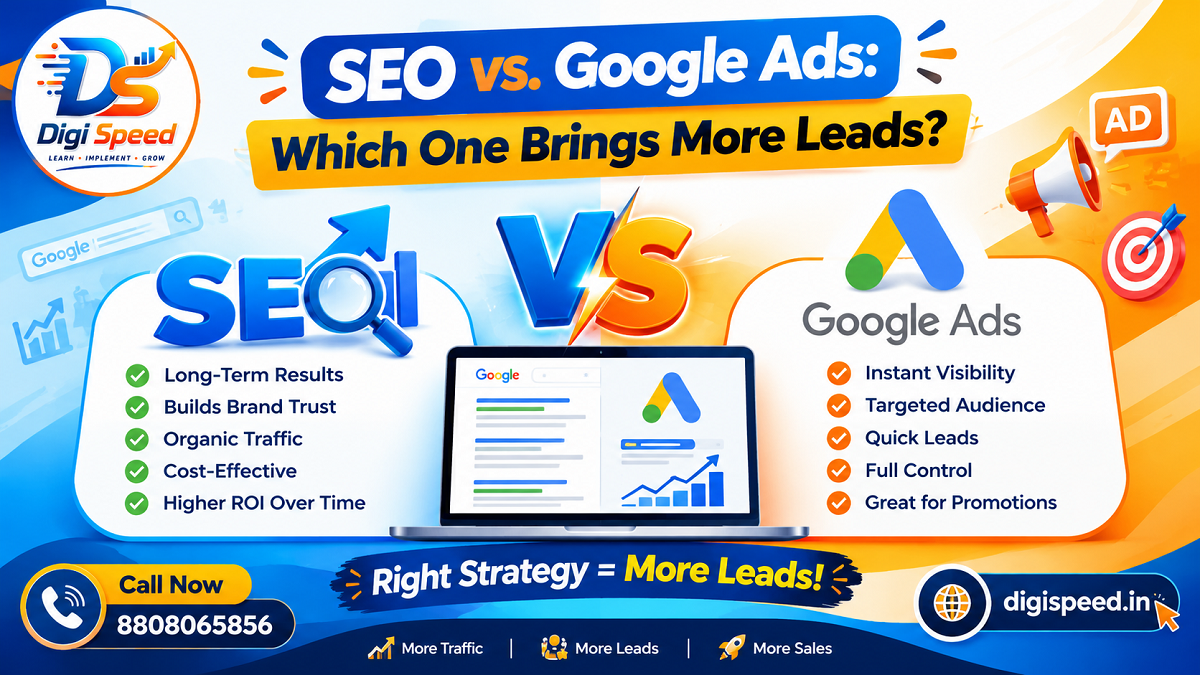
Getting new customers online is not always easy. You may have a great product, offer a useful service, and even have a professional website, but still struggle to generate enough enquiries. This is where digital marketing can make a difference.
Two common ways to attract potential customers are Search Engine Optimization (SEO) and Google Ads. Both help businesses reach people who use Google to find information, products, or services. However, they work in different ways.
SEO helps your website appear in organic search results, while Google Ads allows you to pay for advertising placements that can reach relevant searchers.
But which strategy brings more leads? Is SEO better for long-term growth, or can Google Ads help you find customers faster?
The answer depends on your business goals, marketing budget, competition, and the type of customers you want to reach.
In this guide, you will learn how SEO and Google Ads work, how their costs differ, and how to choose the right strategy for your business.
What Is SEO?
Search Engine Optimization, or SEO, is the process of improving a website so that search engines can understand its content and users can discover it through relevant organic search results.
For example, imagine you own a digital marketing agency. A business owner searches Google for “SEO services for small businesses.” If your website has relevant service pages and useful content, it may appear in the organic results for that search.
SEO does not mean adding keywords everywhere or publishing as many articles as possible. It involves understanding what your audience needs and making your website useful, accessible, and easy to navigate.
Important Parts of SEO
1. Keyword Research
Keyword research helps you understand what your potential customers are searching for. For example, a person searching for “what is SEO” may need information, while someone searching for “hire an SEO agency” may be comparing service providers.
Understanding this difference helps you create content that matches the searcher’s intent.
2. On-Page SEO
On-page SEO includes improving page titles, headings, content, internal links, and other elements that help users and search engines understand a page.
3. Technical SEO
Technical SEO focuses on areas such as crawlability, indexing, website structure, and page accessibility. A technically sound website makes it easier for search engines to discover and understand your content.
4. Content Creation
Useful blog posts, detailed service pages, and practical guides can answer customer questions and help people make informed decisions.
5. Local SEO
Local SEO helps businesses improve their visibility for relevant searches in specific locations. It can be particularly useful for businesses that serve customers in a particular city or area.
Benefits of SEO
SEO can be valuable for businesses that want to build a sustainable online presence.
- It can attract relevant organic visitors without paying for every organic click.
- Useful pages may continue attracting traffic over time.
- Informative content can help build credibility with potential customers.
- A well-structured website can support different stages of the customer journey.
- Organic visibility can reduce dependence on paid advertising over the long term.
However, SEO takes time and consistent effort. Competition, content quality, website conditions, and search intent all affect results. No SEO agency can honestly guarantee a particular Google ranking.
What Is Google Ads?
Google Ads is an online advertising platform that businesses can use to promote their products and services. One common option is Search advertising, where eligible ads may appear when people search for relevant terms on Google.
Read Also: Social Media Strategies That Turn Followers Into Customers
For example, if someone searches for “hire a digital marketing agency,” a business running a relevant Search campaign may appear in the sponsored results.
Advertisers can select keywords, target locations, set budgets, create advertisements, and measure conversions when tracking is configured correctly.
Many Search campaigns use a cost-per-click model, meaning advertisers pay when someone clicks an ad. Actual costs depend on factors such as competition, bidding strategy, and campaign settings.
Benefits of Google Ads
1. Faster Visibility
Unlike SEO, which usually takes time to build organic visibility, an eligible advertising campaign can begin showing ads after approval and setup.
2. Targeted Advertising
Businesses can reach relevant audiences using available targeting options, including search keywords and geographic locations.
3. Budget Management
You can set campaign budgets and adjust them according to your goals and performance.
4. Measurable Results
With suitable conversion tracking, you can measure clicks, enquiries, phone calls, and other meaningful actions.
5. Flexible Testing
Google Ads can help you test different offers, landing pages, and advertising messages to learn what attracts potential customers.
However, Google Ads does not guarantee leads. If your ads attract the wrong audience or your landing page fails to explain your offer clearly, your budget may produce clicks without meaningful business results.
SEO vs Google Ads: Key Differences
Both strategies can attract potential customers, but their approach, cost structure, and long-term value differ.
| Factor | SEO | Google Ads |
|---|---|---|
| Traffic source | Organic search results | Paid advertising placements |
| Time to visibility | Usually takes time | Can begin after approval and setup |
| Cost | Labour, tools, content, and optimization | Advertising spend and campaign management |
| Payment per click | No direct payment to Google for organic clicks | Commonly used in Search campaigns |
| Long-term potential | Pages may continue attracting visitors | Paid traffic generally depends on continued campaigns |
| Budget control | Less direct control over traffic volume | Campaign budgets can be adjusted |
| Best use | Sustainable organic visibility | Targeted promotion and faster testing |
| Main challenge | Competition and time required | Ongoing cost and campaign performance |
Neither strategy guarantees a specific number of leads. Your results depend on the quality of your website, the relevance of your targeting, the offer you provide, and how effectively you convert visitors into enquiries.
Which One Brings More Leads?
The best choice depends on your business and how quickly you need results.
When SEO Is Better for Lead Generation
SEO may be a strong option when your business wants to attract relevant visitors over the long term.
Suppose you provide website design services. You could create useful articles about website development costs, mobile-friendly design, website speed, and choosing a website designer.
These articles can help people understand their problems and explore possible solutions. When relevant service pages are available, some visitors may contact your business.
SEO can be particularly useful when:
- Your customers regularly research services before purchasing.
- You want to build organic visibility over time.
- You can invest in useful content and website improvements.
- Your business has several services or customer questions to cover.
- You want to reduce reliance on paid advertising in the future.
Remember that traffic alone is not the goal. Your content should connect relevant readers with useful next steps, such as a detailed service page or a contact form.
When Google Ads Is Better for Lead Generation
Google Ads may be suitable when you need to promote a service quickly or test whether a particular offer attracts potential customers.
Imagine you run a plumbing business and want to reach people searching for plumbing services in your service area. A carefully targeted Search campaign can help you reach relevant searchers without waiting for organic rankings to improve.
Google Ads can be useful when:
- You want to test demand for a service or offer.
- Your customers search using clear commercial keywords.
- You have a defined advertising budget.
- Your website has a relevant landing page.
- You can measure qualified leads and improve campaign performance.
The important point is to focus on lead quality rather than clicks alone. A campaign that attracts many visitors but generates few genuine enquiries may need better targeting, a clearer offer, or an improved landing page.
SEO vs Google Ads: Which Is More Cost-Effective?
Cost-effectiveness should be measured by the value of the leads you generate, not simply by the amount of traffic you receive.
Consider a hypothetical example.
A business spends ₹20,000 on marketing during a month.
Its Google Ads campaign generates 200 clicks and 10 qualified leads. If the entire ₹20,000 is treated as advertising spend, the advertising cost per qualified lead is ₹2,000.
Now suppose the business spends ₹20,000 on SEO content and optimization, which generates 10 qualified leads during the same period. The marketing cost per qualified lead is also ₹2,000 for that period.
These are illustrative figures, not typical industry results. They also do not establish which channel is better over the long term. SEO pages may continue attracting visitors after the initial investment, while paid traffic generally requires continued advertising spend.
For a fair comparison, include relevant expenses such as agency fees, staff time, content creation, landing pages, and campaign management.
Use these formulas:
Cost per lead = Total marketing cost ÷ Number of leads
Lead conversion rate = Number of leads ÷ Number of visitors or clicks × 100
You should also measure how many leads become paying customers. A low-cost lead is not necessarily valuable if the person is unlikely to buy your product or service.
Can You Use SEO and Google Ads Together?
Yes. Many businesses can benefit from combining SEO and Google Ads because the two strategies can support different marketing goals.
Here is a practical approach.
Step 1: Use Google Ads to Test Commercial Keywords
Start with a focused campaign targeting relevant searches. Measure which keywords generate genuine enquiries rather than relying only on click numbers.
Step 2: Create Helpful SEO Content
Develop service pages and blog posts that answer your audience’s questions. Use customer feedback, keyword research, and campaign insights to identify useful topics.
Step 3: Improve Your Landing Pages
Make sure your page matches what the visitor expected to find. Explain your service, highlight relevant benefits, answer common questions, and make it easy to contact you.
Step 4: Track Conversions
Set up suitable conversion tracking and review the quality of your enquiries. Use the information to improve your ads, landing pages, and organic content.
Step 5: Review Results Regularly
Compare cost per qualified lead, customer acquisition cost, and the value of customers from each channel. Allocate more resources to strategies that produce sustainable business results.
This approach allows you to test paid campaigns while developing an organic presence that may support future growth.
Common Mistakes to Avoid
Choosing the right marketing channel is only part of the process. You also need to avoid mistakes that waste time and money.
1. Expecting Immediate SEO Results
SEO generally requires time. Avoid making business decisions based on unrealistic ranking promises.
2. Running Google Ads Without Tracking
Without conversion tracking, you may not know which campaigns generate genuine enquiries.
3. Choosing Keywords Only for Search Volume
Popular keywords may attract people who are not interested in buying. Focus on relevance and search intent.
4. Sending Every Visitor to the Homepage
A dedicated landing page can be more relevant when someone clicks an ad for a specific service.
5. Ignoring Lead Quality
Track qualified enquiries and sales, not only form submissions.
6. Publishing Content Without Adding Value
Articles should answer real questions and provide useful information. Avoid repetitive content created only to target search keywords.
7. Stopping All Paid Campaigns After SEO Improves
Do not assume one channel must replace the other. Compare their results and keep the channels that make sense for your business.
How to Choose the Right Strategy for Your Business
Before spending money, identify your main goal.
For a new business: Consider a small, carefully measured advertising campaign if you need to test demand, while building a useful website and SEO foundation.
For an established business: Invest in SEO to support organic visibility and use Google Ads to reach relevant commercial searches.
For a local business: Consider local SEO alongside targeted Search advertising when your budget and customer demand justify it.
For a business with a limited budget: Prioritize your most valuable services, improve existing pages, and test marketing activities on a manageable scale.
For long-term growth: Build a library of useful content, strengthen service pages, and use paid campaigns selectively where the cost of acquiring customers is sustainable.
Your decision should be based on your customers, available resources, competition, and business objectives rather than on the popularity of a particular marketing channel.
Frequently Asked Questions
1. Is SEO better than Google Ads?
SEO may be better for building long-term organic visibility, while Google Ads can help businesses reach relevant searchers through paid placements more quickly. The right choice depends on your goals, budget, and lead quality.
2. Do Google Ads guarantee leads?
No. Google Ads can generate traffic and enquiries, but results depend on targeting, competition, ad relevance, landing-page quality, and the offer. Conversion tracking helps you understand campaign performance.
3. How long does SEO take to generate leads?
There is no fixed timeline. Some pages may gain visibility relatively quickly, while competitive topics may take much longer. Results depend on your website, competition, content, and search intent.
4. Can a small business use SEO and Google Ads together?
Yes. A small business can test demand with a focused advertising campaign while improving its organic visibility through useful content and relevant service pages.
5. Should I stop Google Ads when my website ranks on Google?
Not necessarily. Compare qualified leads and customer acquisition costs from both channels. If both are producing profitable results, continuing both may make sense.
6. Which is better for a limited marketing budget?
There is no single answer. SEO can be useful for long-term organic growth, while a small advertising campaign can test demand. Choose the approach that best fits your budget and your ability to measure results.
Conclusion
SEO and Google Ads can both help businesses generate leads, but they work differently.
SEO focuses on improving organic visibility and building long-term value through useful content and website optimization. Google Ads allows businesses to reach relevant searchers through paid advertising, making it useful for targeted campaigns and faster testing.
If you need to test demand quickly, Google Ads may be a suitable starting point. If you want to develop sustainable organic traffic, SEO deserves attention. If your resources allow, combining both can provide a balanced approach.
The most important step is to measure qualified leads, customer acquisition costs, and actual business results.
At Digispeed.in, focus on making informed marketing decisions based on your business goals, audience, and budget. With the right strategy and consistent improvement, you can build a stronger online presence and create more opportunities to connect with potential customers.

Saurabh Kumar Shrivastav is a Digital Marketing Expert, Web Designer & Developer, and Founder of Digispeed.in, with 12+ years of experience in digital marketing and web solutions. He shares practical insights on SEO, Google Ads, social media, content marketing, web development, and online business growth to help readers build and grow their online presence.