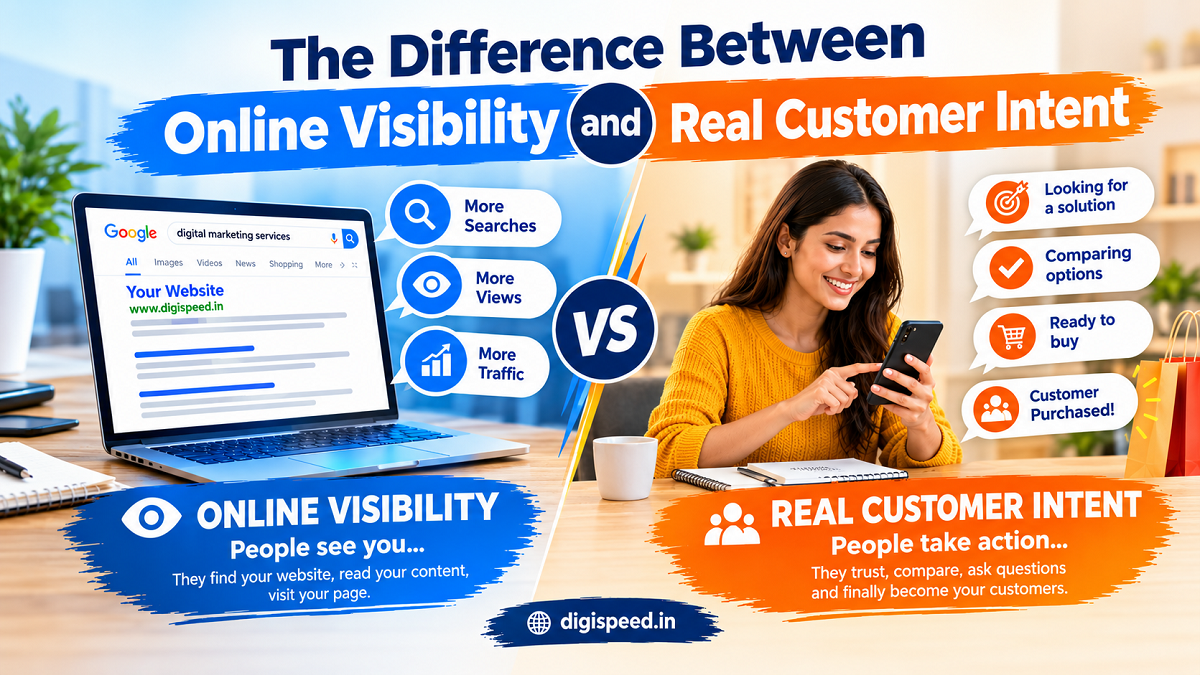
A business can be visible online and still struggle to get customers.
Your website may appear in Google Search. Your Instagram posts may receive views. Your business profile may get impressions. A Google Ads campaign may generate clicks. On the surface, everything can look active.
But there is another question that matters much more:
Are the people seeing your business actually interested in buying what you offer?
This is where the difference between online visibility and real customer intent becomes important.
Online visibility means people can discover your business through search engines, social media, advertisements, maps, websites, and other digital channels. Customer intent is different. It describes what a person is actually trying to do when they search, click, visit a website, compare businesses, or contact a company.
Visibility can bring attention. Intent can bring action.
Understanding this difference can help a business spend its digital marketing budget more carefully and create content that is useful to people who are genuinely looking for a solution.
What Is Online Visibility?
Online visibility is the overall presence of a business across digital platforms.
For example, a business may be visible through:
- Google Search results
- Google Business Profile
- Social media
- Google Ads
- YouTube
- Blog posts
- Business directories
- Email marketing
- Other websites
- Local search results
A business with strong online visibility may appear in many places when people search for information related to its products or services.
For example, imagine a website development company publishes an article about website speed. Thousands of people may find that article through Google.
That sounds positive, but not every visitor is looking for website development services.
Some may simply want to understand why their website is slow. Others may be students researching the topic. Some may be developers looking for technical information.
The website has gained visibility, but that does not automatically mean it has gained potential customers.
What Is Real Customer Intent?
Customer intent is the purpose behind a person’s online action.
When someone searches on Google, they usually have a reason.
One person may search:
“What is SEO?”
Another may search:
“SEO agency for small business in Delhi.”
Both searches are related to SEO, but the intent behind them is very different.
The first person may be learning.
The second person may already be looking for a service provider.
This distinction is extremely important for digital marketing.
A business should not only ask, “How many people saw my content?”
It should also ask:
“What were those people trying to accomplish when they found me?”
Visibility and Intent Are Not the Same Thing
A common mistake is treating website traffic, social media reach, impressions, and clicks as direct indicators of business growth.
These numbers are useful, but they need context.
For example, suppose a website receives 10,000 visitors in a month but only a few relevant enquiries.
Another website receives 1,500 visitors and generates considerably more enquiries.
The second website may have less overall visibility, but its traffic could have stronger commercial intent.
This does not mean that high traffic is bad. Traffic can help build awareness, authority, and future demand.
The important point is that traffic volume alone cannot tell the complete story.
A business needs to understand who is visiting, why they arrived, what information they are looking for, and what they do after reaching the website.
A Simple Example of Search Intent
Consider a person looking for digital marketing services.
They might go through several searches during their buying journey.
First, they could search:
“how digital marketing works for small businesses”
Later, they might search:
“digital marketing services for small business”
After comparing different providers, they could search:
“digital marketing agency in Delhi”
These searches represent different stages of the same journey.
The first search is more educational.
The second is closer to commercial research.
The third shows a stronger possibility that the person is evaluating service providers.
A good digital marketing strategy understands these differences instead of treating every keyword as if it represents the same customer.
Why High Visibility Can Sometimes Produce Low Business Results
There are several reasons a business can receive attention without receiving enough meaningful enquiries.
1. The Content Attracts the Wrong Audience
A blog post may rank well for a popular keyword, but the people visiting it may not need the company’s service.
For example, an agency may publish an article that attracts beginners searching for basic digital marketing definitions.
The article could receive substantial traffic, but many readers may not be potential clients.
The content is successful from a visibility perspective, but less useful from a lead-generation perspective.
2. The Keyword Does Not Match the Business Goal
Not every keyword should be judged only by search volume.
A keyword with thousands of searches may be less valuable to a particular business than a keyword with a much smaller audience but stronger commercial relevance.
For a service business, understanding the relationship between the keyword and the customer’s problem can be more useful than chasing the biggest possible search volume.
3. The Landing Page Does Not Match the Visitor’s Intent
Imagine someone searches for “Google Ads management service” and lands on a general homepage.
The visitor may have expected information about Google Ads management, pricing factors, process, campaign management, or what is included in the service.
If the page does not quickly address that need, the visitor may leave.
The problem may not be a lack of traffic.
The problem may be a mismatch between what the visitor expected and what the page provides.
4. The Website Creates Awareness but Not Enough Trust
Customers often compare businesses before making a decision.
They may check the website, services, about page, reviews, social profiles, examples of work, contact options, and other available information.
If the website provides very little useful information, visitors may hesitate even when they are genuinely interested.
Visibility gets someone to the door.
Useful information and trust can help them decide what to do next.
How to Identify Real Customer Intent
You do not have to guess customer intent entirely.
You can study actual behaviour.
Start with the searches bringing visitors to your website.
Look for patterns such as:
- What terms are people using?
- Are they searching for information or a service?
- Are they looking for a local provider?
- Are they comparing solutions?
- Are they searching for prices?
- Are they looking for a specific product or service?
- Which pages do they visit after landing?
- Which pages generate enquiries?
Google Search Console can help businesses understand how their pages appear in Google Search and which queries bring search traffic.
Analytics data can then provide additional context about what visitors do after arriving.
The goal is not simply to collect numbers.
The goal is to understand the journey behind those numbers.
Look Beyond Clicks
Clicks are only one part of the picture.
Suppose a Google Ads campaign receives 500 clicks.
That number may initially look encouraging.
But imagine that most clicks come from searches that are only loosely related to the service. The campaign may generate activity without generating enough useful enquiries.
Read Also: Getting Views, Clicks & Traffic But No Customers? Find Out Why
Now consider another campaign that receives 150 highly relevant clicks and produces several serious enquiries.
The second campaign may deserve closer attention because the traffic has stronger business relevance.
This is why digital marketing decisions should not be based on a single metric.
Depending on the business, useful signals can include:
- Relevant website visits
- Enquiry submissions
- Phone calls
- WhatsApp conversations
- Product enquiries
- Appointment requests
- Qualified leads
- Returning visitors
- Engagement with important service pages
The right measurement depends on the actual business objective.
Match Content With Different Customer Intent
One of the practical ways to improve digital marketing is to create content for different stages of the customer journey.
Informational Content
This helps people understand a problem.
Examples:
- What is SEO?
- How does Google Ads work?
- What is a landing page?
- Why does website speed matter?
This type of content can introduce people to a subject.
Commercial Research Content
At this stage, people may be comparing solutions.
Examples:
- SEO services for small businesses
- Google Ads management services
- Website development services
- SEO agency vs freelancer
The visitor may not be ready to contact a company immediately, but they are moving closer to a decision.
Transactional or Service-Focused Content
Here, the visitor may already know what they want.
Examples:
- SEO service in India
- Digital marketing agency in Delhi
- Google Ads management service
- Website development company
These pages should make the service, process, expectations, and next steps clear.
Creating this type of content helps a website serve people at different stages instead of publishing articles only to generate visits.
Social Media Visibility Also Needs Context
The same principle applies to social media.
A post can receive thousands of views without producing a single meaningful enquiry.
That does not automatically make the post unsuccessful.
Some content is designed for awareness. Some is designed to educate. Some is designed to generate enquiries.
The mistake is expecting every social media post to perform the same job.
A business should define the purpose of its content before judging its performance.
For example:
Awareness content may introduce the brand.
Educational content may solve a common problem.
Service content may explain what the business provides.
Conversion-focused content may encourage an interested person to enquire.
A healthy digital presence can contain a combination of these.
The Customer Journey Is More Important Than a Single Visit
People rarely make every business decision from one interaction.
Someone may first discover a company through Google.
Later, they may see its Instagram profile.
A few days later, they may return to the website.
They may read a blog post, check the services page, look at the contact information, and finally send a WhatsApp message.
If you only look at the first visit, you may miss the larger journey.
This is why businesses should think about the complete experience rather than treating every click as an isolated event.
How Digi Speed Approaches This Difference
At Digi Speed, digital marketing is not only about making a business visible online.
The bigger objective is to connect digital activity with the needs of the people a business actually wants to reach.
That can involve areas such as SEO, Google Ads, social media marketing, website development, content marketing, and other digital channels.
Each channel has a different role.
SEO can help people discover relevant information through search.
Google Ads can help businesses appear for selected searches.
Social media can help build awareness and engagement.
A well-structured website can provide the information visitors need before making contact.
The important part is connecting these activities rather than treating them as completely separate tasks.
A Practical Way to Think About Your Digital Marketing
Before investing more money into traffic, ask yourself five simple questions:
1. Who am I trying to reach?
Be specific about the type of customer you want.
2. What problem are they trying to solve?
Understand the problem instead of focusing only on your service name.
3. What would they search for?
Think about the actual words and phrases they might use.
4. What would they expect after clicking?
Your page should provide information that matches the reason they arrived.
5. What should they do next?
Make the next step clear without forcing the visitor.
This approach can make digital marketing more customer-focused.
Final Thoughts
Online visibility is important because customers cannot discover a business they cannot find.
But visibility is only one part of digital marketing.
The more important question is whether your online presence is reaching people with a genuine need for what you offer.
A website can have traffic without producing enough enquiries. A social media profile can have followers without generating customers. An advertising campaign can have clicks without producing qualified leads.
These situations do not always mean that digital marketing has failed.
They may indicate that visibility and customer intent are not properly connected.
The goal should therefore be to build a digital presence that does more than attract attention. It should help the right people find useful information, understand the available solution, develop confidence, and take the next appropriate step.
When businesses understand the difference between being seen and being relevant, digital marketing becomes less about chasing numbers and more about creating meaningful connections with potential customers.
For any digital marketing strategy, the starting point should be simple: reach the right people, understand what they need, and give them useful information at the right stage of their journey.

Saurabh Kumar Shrivastav is a Digital Marketing Expert, Web Designer & Developer, and Founder of Digispeed.in, with 12+ years of experience in digital marketing and web solutions. He shares practical insights on SEO, Google Ads, social media, content marketing, web development, and online business growth to help readers build and grow their online presence.