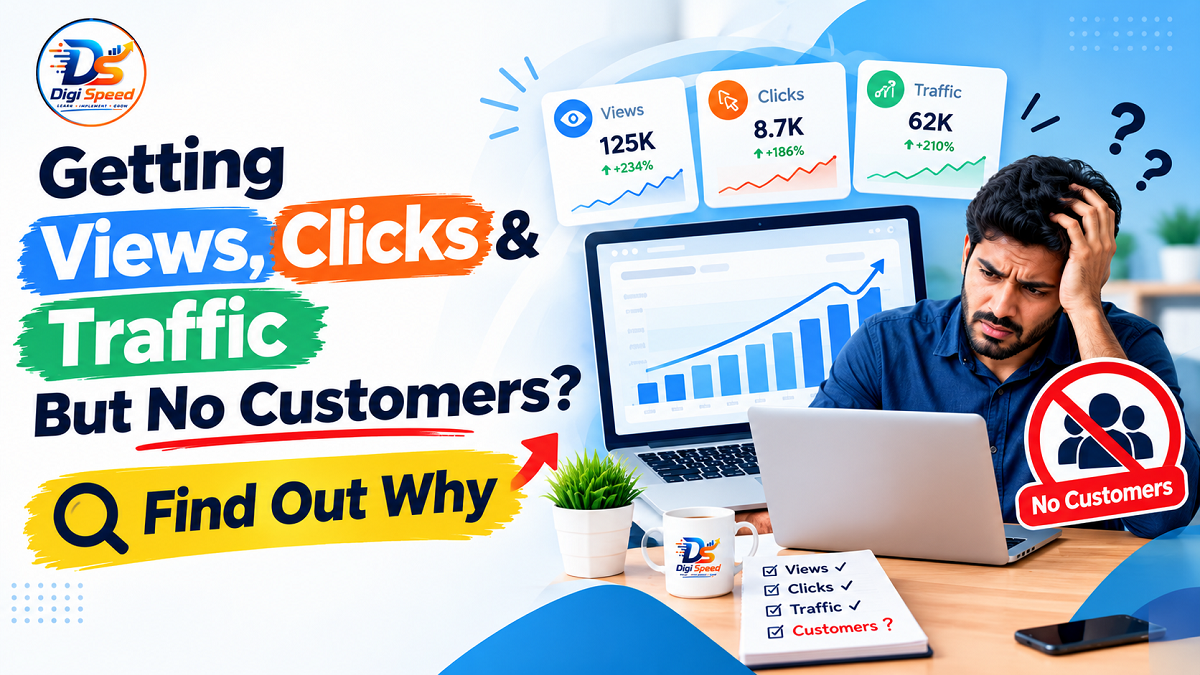
You are getting views on social media. People are clicking your ads. Your website is receiving traffic from Google. Your analytics numbers may even look better than before.
But there is one problem:
Where are the customers?
This is one of the most frustrating problems for businesses doing digital marketing.
You may be investing money in Google Ads, SEO, social media marketing, content marketing or website promotion, but the number of enquiries and customers may still be disappointing.
The problem is not always that your digital marketing is failing.
Sometimes people are reaching your business, but something is stopping them from taking the next step.
They may not understand your offer, trust your business, find the website confusing, see the wrong information, land on a weak page, or simply have no clear reason to contact you.
In this article, we will look at the most common reasons businesses get views, clicks and traffic but fail to turn that attention into real customers.
Traffic Is Not the Same as Customers
One of the first things to understand is that traffic and customers are two different things.
Website traffic tells you that people are visiting your website.
A click tells you that someone was interested enough to visit a page.
A view tells you that someone saw your content.
But none of these automatically means that the person is ready to buy.
For example, imagine 10,000 people visit your website in one month.
If only 20 people contact you and only 2 become customers, the traffic number alone does not tell the complete story.
Your real question should be:
What happens after people arrive?
This is where you need to look beyond traffic and understand your complete customer journey.
1. You May Be Attracting the Wrong Audience
Getting more traffic is not always the solution.
You need to get relevant traffic.
Imagine you sell professional SEO services for businesses.
If your website receives thousands of visitors searching for:
- Free SEO tools
- SEO course
- SEO meaning
- SEO jobs
- SEO interview questions
those visitors may not be looking to hire an SEO agency.
You can have excellent traffic numbers and still receive very few enquiries.
The problem may be audience targeting.
Your marketing should reach people who have a genuine need for the product or service you provide.
Before celebrating traffic growth, ask:
Are the people visiting my website actually potential customers?
2. Your Offer May Not Be Clear
A visitor should quickly understand what you offer.
If someone lands on your homepage and has to spend several minutes figuring out:
- What you do
- Who you help
- What service you provide
- Why they should choose you
- How to contact you
you may lose that visitor.
Your main message should be simple.
For example:
Instead of a headline such as:
“Transforming Businesses Through Next-Generation Digital Solutions”
you could communicate something more specific:
“SEO Services That Help Local Businesses Get More Search Visibility and Leads”
The second message tells the visitor what the business does and who the service is for.
Clarity reduces confusion.
3. Your Website Gets Traffic But Does Not Build Trust
People do not become customers simply because they find your website.
They also need a reason to trust your business.
A visitor may ask:
Is this company genuine?
Can they actually provide this service?
Do they understand my problem?
Can I safely contact them?
Your website should make these questions easier to answer.
Depending on your business, trust can be supported by:
- Clear business information
- About page
- Contact information
- Service details
- Real examples
- Case studies
- Client experiences
- Clear policies
- Author information where appropriate
- Relevant credentials or experience
- Professional website presentation
Do not add fake reviews, fake results or invented credentials simply to make the business look more trustworthy.
Trust comes from accurate information and evidence.
4. Your Landing Page May Be the Real Problem
A person can click your advertisement and still leave immediately.
Why?
Because the landing page does not match what they expected.
Suppose your Google Ad says:
“SEO Services for Small Businesses”
but the visitor lands on a generic homepage containing information about ten different services.
The visitor now has to search for the information promised in the advertisement.
That creates friction.
A relevant landing page should continue the message from the advertisement.
If the advertisement promotes SEO services, the landing page should clearly explain:
- The SEO service
- Who it is for
- What problem it solves
- What the process involves
- What the visitor should do next
The same principle applies to social media campaigns and other traffic sources.
5. Your Call-to-Action Is Weak or Missing
Sometimes the visitor is interested but does not know what to do next.
This is where a clear call-to-action matters.
Depending on your business, your CTA could be:
- Get a Free Consultation
- Request a Quote
- Book a Demo
- Contact Us
- Call Now
- Get a Website Audit
- Request More Information
The CTA should match the visitor’s stage in the buying journey.
Someone researching a service may not be ready to “Buy Now.”
A softer action such as “Book a Free Consultation” may make more sense.
The important thing is that the next step should be obvious.
6. Your Marketing Message May Be Too Generic
Another common problem is saying the same thing as every competitor.
For example:
“We provide high-quality digital marketing services.”
Almost every agency can say that.
It does not explain why the visitor should care.
Instead, focus on the problem you solve.
For example:
“Struggling to turn website visitors into qualified leads? We help businesses improve SEO, paid campaigns and landing-page conversions.”
The second message connects the service with a specific business problem.
Your marketing becomes more meaningful when the customer can recognize their own situation in your message.
7. Your SEO Traffic May Not Match Buying Intent
SEO can bring visitors at different stages of the buying journey.
Someone searching:
“What is digital marketing?”
is probably at an early research stage.
Someone searching:
“digital marketing agency in Delhi“
may have stronger commercial intent.
Someone searching:
“hire SEO agency for small business”
may be even closer to contacting a provider.
This does not mean informational keywords are useless.
They can help build awareness and authority.
But you should understand what each type of search is trying to accomplish.
Your website should have content for different stages while making it easy for relevant visitors to move toward the next useful step.
8. Your Google Ads May Be Getting Clicks Without Producing Leads
If you are running Google Ads, do not judge campaign performance only by clicks.
A campaign can generate many clicks and still produce few enquiries.
Check:
- Search terms
- Keyword targeting
- Match types
- Ad messaging
- Landing pages
- Location targeting
- Device performance
- Conversion tracking
- Lead quality
- Cost per conversion
You need to know what happens after the click.
If 100 people click your advertisement but nobody contacts you, increasing the advertising budget may not solve the problem.
First investigate why those visitors are not converting.
9. Your Social Media Content May Be Creating Attention Instead of Demand
Social media is excellent for visibility and awareness, but views do not automatically become customers.
A Reel can receive thousands of views because it is entertaining.
That does not mean every viewer needs your service.
If your goal is generating business enquiries, your content should also help people understand:
- What problem you solve
- Who you help
- What makes your service useful
- What result the service is designed to support
- What action they can take next
Not every social media post needs to sell.
But your overall content strategy should have a clear connection between awareness, consideration and action.
10. Your Website May Be Too Difficult to Use
Imagine a potential customer visits your website from a mobile phone.
The page loads slowly.
The text is difficult to read.
The contact button is difficult to find.
The form has too many fields.
The visitor has to click through several pages before finding basic information.
That visitor may leave even if they were genuinely interested.
Google’s current page-experience guidance encourages website owners to provide an overall good experience, including mobile usability, secure pages, Core Web Vitals, clear content and avoiding intrusive elements that interfere with the main content.
So check your website from a real mobile device, not only from your desktop computer.
11. Your Contact or Lead Form May Have Too Much Friction
A potential customer may want to contact you but abandon the form if it asks for too much information.
For example, asking for:
- Full name
- Phone
- Company name
- Company address
- Website
- Monthly revenue
- Number of employees
- Marketing budget
- Detailed requirements
may be unnecessary for a first contact.
Only ask for information that you actually need at that stage.
A shorter form can make the first interaction easier.
You can collect additional information later.
12. You May Not Be Tracking Conversions Correctly
This is a major issue because you cannot improve what you cannot measure.
You should know what happens after someone visits your website.
Depending on your business, important conversion actions may include:
- Contact form submissions
- Phone calls
- WhatsApp conversations
- Demo bookings
- Quote requests
- Purchases
- Appointment bookings
If your tracking is incomplete, you may believe a campaign is not working when it is actually generating leads.
Read Also: Website Ranking Dropped After Google Update? Fix It Fast
Or the opposite can happen: you may continue spending money on traffic that does not generate meaningful business results.
Set up reliable conversion tracking and regularly compare traffic with actual business outcomes.
13. You Are Measuring the Wrong Numbers
Traffic is useful, but traffic alone does not tell you whether your marketing is producing business.
Instead of looking only at:
“How many visitors did I get?”
also ask:
- How many leads did I generate?
- How many qualified leads did I receive?
- How many people contacted the business?
- How many sales were generated?
- What was the cost per lead?
- What was the cost per customer?
- Which channel generated the best-quality enquiries?
A smaller number of relevant visitors can sometimes be more valuable than a much larger amount of irrelevant traffic.
The right measurement depends on your business model.
14. You Are Sending Traffic to the Wrong Page
Another common problem is sending every visitor to the homepage.
A homepage has to serve many purposes.
A dedicated service page or landing page can be much more focused.
For example:
Google Ads → Google Ads service landing page
SEO campaign → SEO service page
Website design advertisement → Website design landing page
The closer the page matches the visitor’s expectation, the easier it becomes for that visitor to understand what to do next.
15. Your Follow-Up May Be Losing Potential Customers
Getting a lead is not the same as getting a customer.
Imagine someone fills out your form and asks for information.
If nobody responds for two days, the person may already have contacted another business.
Your marketing process should include a clear lead follow-up system.
Depending on your business, that could include:
- Quick response to enquiries
- WhatsApp follow-up
- Email response
- Phone call
- Requirement confirmation
- Proposal
- Scheduled consultation
Digital marketing can bring the lead, but your sales process still has to handle it properly.
A Simple Way to Find Your Real Problem
If your business is getting traffic but not customers, divide your marketing journey into five stages:
Stage 1: Visibility
Are people seeing your business?
Examples:
- Search impressions
- Social media views
- Ad impressions
Stage 2: Interest
Are people taking an action?
Examples:
- Website clicks
- Ad clicks
- Profile visits
- Video engagement
Stage 3: Website Visit
Are visitors finding what they expected?
Check:
- Landing page
- Message
- Page speed
- Mobile experience
- Content
- Trust signals
Stage 4: Conversion
Are visitors taking the desired action?
Examples:
- Contact form
- Phone call
- WhatsApp message
- Booking
- Purchase
Stage 5: Customer
Are qualified leads actually becoming paying customers?
If you identify the stage where people are dropping off, you can investigate that part instead of changing your entire marketing strategy.
What Should You Fix First?
Do not try to change everything at the same time.
Start with the biggest visible problem.
If you have low traffic, investigate SEO, targeting, content and distribution.
If you have traffic but irrelevant visitors, review your targeting and search intent.
If you have relevant traffic but no enquiries, investigate your landing pages, offer, trust, CTA and website experience.
If you have many leads but few customers, investigate lead quality, sales communication, pricing, offer positioning and follow-up.
This approach helps you solve the actual bottleneck.
A Practical Digital Marketing Checklist
Before spending more money on marketing, check these questions:
Traffic
- Am I reaching the right audience?
- Which channels are sending visitors?
- Which keywords are bringing traffic?
- Are visitors relevant to my business?
Website
- Is my main offer immediately clear?
- Does the landing page match the marketing message?
- Is the website easy to use on mobile?
- Does the website load properly?
- Can visitors easily contact me?
Content
- Does my content solve a real customer problem?
- Is the information original and useful?
- Does it match search intent?
- Am I creating content for people rather than only for search engines?
Google’s Search guidance recommends creating helpful, reliable, people-first content and specifically encourages creators to evaluate originality, completeness, first-hand expertise, accuracy and whether the content genuinely satisfies the reader.
Conversion
- Is my CTA clear?
- Is my contact form simple?
- Is there an easy way to call or message?
- Am I tracking conversions correctly?
Sales
- How quickly do I respond to leads?
- Are leads being followed up?
- Are qualified leads turning into customers?
- Where are potential customers dropping out?
Don’t Just Buy More Traffic
When a business is not getting customers, the first reaction is often:
“We need more traffic.”
But more traffic is not always the answer.
If your website receives 1,000 visitors and does not convert them, increasing that number to 10,000 may simply give you more visitors who leave without taking action.
Before increasing traffic, understand your conversion process.
Fix the obvious problems first.
Then work on increasing qualified traffic.
Final Thoughts
Getting views, clicks and website traffic but no customers does not necessarily mean that digital marketing is useless.
It usually means that you need to look at the complete journey between attention and purchase.
Your audience may be wrong.
Your message may be unclear.
Your landing page may not match your advertisement.
Your website may not build enough trust.
Your CTA may be weak.
Your conversion tracking may be incomplete.
Or your sales follow-up may be losing leads after they contact you.
The solution is not to blindly spend more money or publish more content.
Start with the data.
Find where potential customers are dropping out.
Then improve that specific part of the journey.
Digital marketing works best when SEO, advertising, content, website experience, conversion tracking and sales follow-up work together toward the same business goal.
If you are getting views, clicks and traffic but still not getting customers, don’t just ask how to get more visitors. Ask what is stopping the visitors you already have from becoming leads and customers.
That question can help you find the real problem.

Saurabh Kumar Shrivastav is a Digital Marketing Expert, Web Designer & Developer, and Founder of Digispeed.in, with 12+ years of experience in digital marketing and web solutions. He shares practical insights on SEO, Google Ads, social media, content marketing, web development, and online business growth to help readers build and grow their online presence.