Artificial intelligence has become a part of everyday technology. From chatbots and writing assistants to search tools and coding applications, AI is being used in many different ways. One of the most important technologies behind modern AI applications is the Large Language Model (LLM).
You may have heard terms such as ChatGPT, AI chatbot, generative AI, or language model. These technologies can answer questions, write text, summarize information, translate languages, help with coding, and perform many other language-related tasks.
But what exactly is a Large Language Model, and how does it work?
In this guide, we will explain LLMs in simple language, including what they are, how they learn, how they generate responses, their common uses, benefits, limitations, and why they are becoming important in modern technology.
What Is a Large Language Model?
A Large Language Model, commonly called an LLM, is an artificial intelligence system designed to understand and generate human-like text.
The word “large” refers mainly to the huge amount of data and the large number of parameters used to train these models. During training, an LLM processes a very large collection of text and learns patterns in language.
Read Also: Why Is My Blog Post Indexed but Not Ranking for Its Keyword?
For example, when you ask an LLM a question, it does not simply search for a ready-made sentence and copy it. Instead, the model uses patterns learned during training to predict what words or pieces of text should come next based on the context of your request.
This allows LLMs to produce responses that can appear natural and conversational.
Some well-known applications of large language models include AI chatbots, writing assistants, translation tools, programming assistants, customer-support systems, and content-generation applications.
How Do Large Language Models Work?
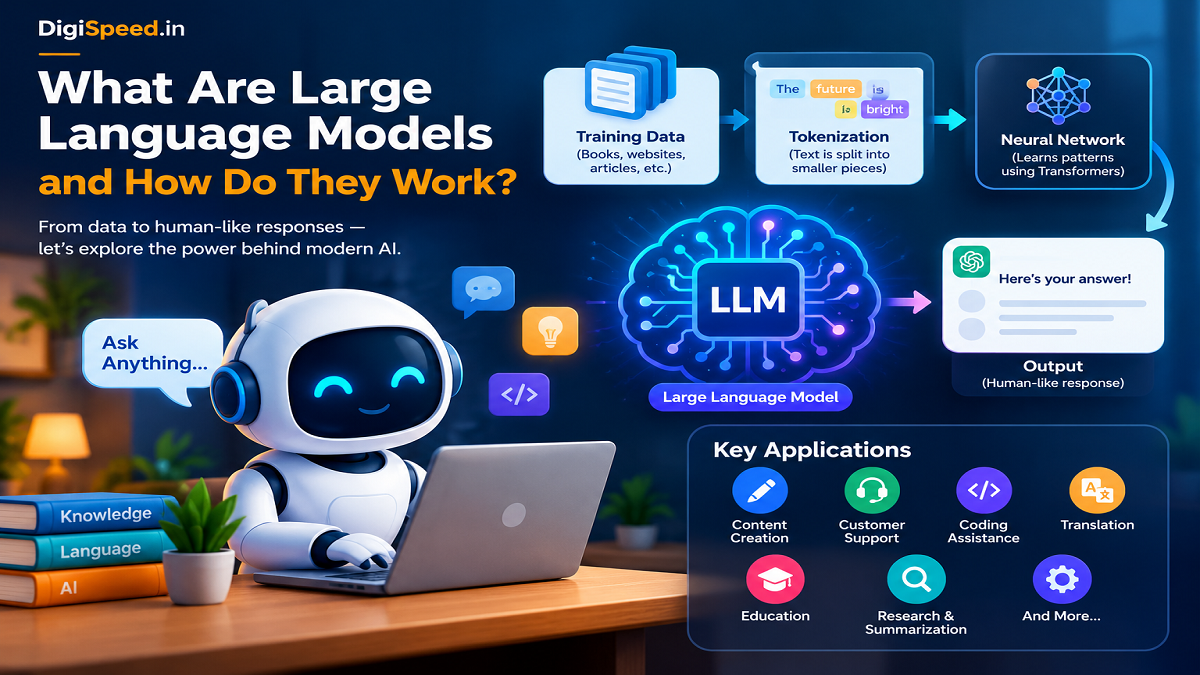
At a basic level, an LLM works by learning patterns from large amounts of text and then using those patterns to generate new text.
The process can be understood through several important steps.
1. Collecting Training Data
Before an LLM can generate useful responses, it needs to be trained.
Training involves processing large amounts of text from sources such as books, websites, articles, documents, and other datasets. The exact data used depends on the model and its developer.
Recommended Tool: Free LLMs.txt Generator
The purpose of training is not simply to memorize individual sentences. Instead, the model learns relationships between words, phrases, concepts, and different patterns of language.
For example, if a model sees many examples of sentences containing the words “The sky is”, it can learn that words such as “blue” may commonly appear afterward.
With enough training examples, the model can learn much more complex language patterns.
2. Breaking Text Into Tokens
LLMs usually do not process an entire sentence exactly as humans read it.
Instead, text is divided into smaller pieces called tokens.
A token can be a complete word, part of a word, punctuation, or another small piece of text.
For example, a sentence may be divided into several tokens before the model processes it.
This token-based approach allows the model to work with different types of text efficiently.
When you type a question into an AI chatbot, your message is converted into tokens before the model processes it.
3. Learning Patterns
During training, the model learns statistical and mathematical relationships between tokens.
The model repeatedly receives examples and adjusts its internal parameters so that it becomes better at predicting the next token.
For instance, consider the sentence:
“The sun rises in the…”
A language model may learn that “east” is a likely continuation.
However, modern LLMs learn far more complicated relationships than simple word associations. They can identify patterns involving grammar, writing style, context, programming syntax, and relationships between concepts.
This learning process requires significant computing power and specialized hardware.
4. Using Neural Networks
Large language models are based on neural network architectures.
Many modern LLMs use an architecture called the Transformer.
Transformers are particularly useful for language because they can process relationships between different parts of a sequence.
One important concept in Transformer-based models is attention.
Attention helps the model determine which parts of the input are more relevant when processing a particular token.
For example, in a long sentence, the meaning of a word may depend on information that appeared several words earlier. Attention mechanisms help the model consider those relationships.
This is one of the key technologies that made modern large language models possible.
How Does an LLM Generate an Answer?
When you enter a prompt, the model first processes the text and converts it into tokens.
It then analyzes the context and calculates possible next tokens.
The model selects a token based on its learned patterns and the settings used for generation. It then continues the process repeatedly until it produces a complete response.
For example, if you ask:
“What is digital marketing?”
The model generates the response step by step, selecting appropriate tokens based on the question and the context.
This happens extremely quickly, which is why an AI chatbot can generate a long response within seconds.
An important point is that an LLM does not think exactly like a human. Its response is generated through mathematical computations based on patterns learned during training and the context provided in the conversation.
What Are Large Language Models Used For?
LLMs have many practical applications.
Content Writing
LLMs can help create drafts, outlines, product descriptions, emails, social media posts, and other types of written content.
However, human review is still important, especially when accuracy, originality, or expert knowledge is required.
Customer Support
Businesses can use language models to help answer common customer questions, summarize conversations, and support customer-service teams.
Coding
LLMs can help developers understand programming concepts, generate code examples, explain errors, and suggest possible solutions.
They can be useful learning and productivity tools, but generated code should be reviewed and tested before being used in real projects.
Translation
Language models can assist with translation and multilingual communication by understanding patterns across different languages.
Education
Students and learners can use AI tools to understand difficult concepts, generate examples, practice questions, and receive explanations in simpler language.
Research and Summarization
LLMs can help summarize long documents, organize information, and create initial research notes. Important facts should still be checked against reliable sources.
What Are the Benefits of LLMs?
Large language models offer several useful benefits.
Fast responses: They can generate text and provide assistance within seconds.
Wide range of applications: The same basic technology can support writing, coding, education, customer service, and many other tasks.
Natural language interaction: Users can communicate with AI using ordinary language instead of learning complicated commands.
Productivity support: LLMs can help people create drafts, summarize information, brainstorm ideas, and complete repetitive language-related tasks.
Accessibility: AI assistants can make information easier to understand by explaining complicated subjects in simpler terms.
What Are the Limitations of LLMs?
Despite their capabilities, LLMs are not perfect.
They Can Make Mistakes
An LLM can generate information that sounds convincing but is incorrect. This is sometimes referred to as an AI hallucination.
For important subjects, users should verify information with reliable and authoritative sources.
They Do Not Have Human Understanding
Although an LLM can produce human-like language, that does not mean it understands the world in exactly the same way a person does.
Its output is based on learned patterns and the information available in the current context.
Training Data Matters
The quality, coverage, and limitations of training data can influence a model’s responses.
Privacy Requires Attention
Users should be careful about entering sensitive personal, financial, confidential, or business information into AI tools. The privacy practices of an AI service should be reviewed before using it for sensitive information.
What Is the Future of Large Language Models?
LLMs are continuing to develop rapidly.
Future AI systems are expected to become more capable at working with different types of information, including text, images, audio, video, and software tools.
We are also seeing AI systems being integrated into search engines, business software, educational platforms, development tools, and everyday applications.
Read Also: Why Does My Google Ads Search Term Report Show Keywords I Never Added?
However, the future of LLM technology will not depend only on making models larger. Improvements in accuracy, efficiency, safety, reliability, privacy, and usefulness are also important.
As the technology develops, understanding how LLMs work can help individuals and businesses make better decisions about when and how to use AI.
Final Thoughts
Large Language Models are an important part of modern artificial intelligence. They are trained on large amounts of data to learn patterns in language and use those patterns to generate responses.
Most modern LLMs use advanced neural network architectures such as Transformers. When a user provides a prompt, the model processes the input as tokens and generates a response by predicting suitable tokens based on the context.
From content creation and education to coding and customer support, LLMs have many practical applications. At the same time, they can make mistakes and should not automatically be treated as a source of truth.
The best way to use an LLM is to understand both its capabilities and its limitations. With responsible use and appropriate human review, large language models can be valuable tools for learning, communication, research, and productivity.
Frequently Asked Questions
What does LLM stand for?
LLM stands for Large Language Model. It is an AI model designed to process and generate human-like language.
How do LLMs learn?
LLMs learn patterns from large amounts of training data. During training, their parameters are adjusted so the model becomes better at predicting tokens and understanding language patterns.
Are LLMs the same as chatbots?
Not exactly. An LLM is an underlying AI model, while a chatbot is an application or interface that can use an LLM to communicate with users.
Can LLMs make mistakes?
Yes. LLMs can produce incorrect or misleading information. Important information should be verified using reliable sources.
Why are LLMs important?
LLMs can understand and generate language, making them useful for applications such as writing, coding, education, customer support, summarization, and translation.
Do LLMs think like humans?
No. Although their responses can appear conversational, LLMs generate text using computational processes and patterns learned during training rather than human-like consciousness or understanding.

Saurabh Shrivastav is a Digital Marketing Expert, Web Designer & Developer, and founder of Digispeed.in, with 12+ years of experience in digital marketing and web solutions. He shares practical insights on SEO, Google Ads, social media marketing, content marketing, web design, development, and online business growth.